Tuesday, January 15, 2013

Chapter 15: Fever 'n' Ague


"'Charles, do look at the girls," she said. "I do believe they are sick."

"Well, I don't feel too well myself," said Pa. "First I'm hot and then I'm cold, and I ache all over. Is that the way you feel, girls? Do your very bones ache?"

Mary and Laura said that was the way they felt. Then Ma and Pa looked a long time at each other and Ma said, "The place for you girls is bed.'"

Blackberries are ripe, and every long, hot afternoon Laura goes with Ma to help pick them. They grow in the brier-patches down in the creek bottom. Clouds of mosquitoes follow Ma and Laura wherever they go in the bushes. The mosquitoes like to suck the sweet juice from the blackberries, but they like to bite Laura and Ma just as much.

It is hard, itchy, pokey, sticky work, but every day they bring home pails full of berries to dry in the sun. And every day they eat as many berries as they want. Next winter they will have blackberries to stew.

Mary stays with Baby Carrie because she is older. There are hardly any mosquitoes in the house during the day, but at night, if there is no wind, the mosquitoes come in swarms. Pa burns smudge fires of damp grass to keep them away, but a good many come anyway.

Pa can't play his fiddle in the evenings because of the mosquitoes. Mr. Edwards does not come visiting anymore because of the mosquitoes. Pet and Patty and the colt and the calf and the cow are miserable because of the mosquitoes. And Laura is covered in mosquito bites.

"This won't last long," Pa says. "Fall's not far away, and the first cold wind will settle 'em."

But one morning Laura doesn't feel good. She feels cold even in the hot sun. Mary feels sick too. Ma feels Laura's cheek. "You can't be cold," she says. "Your face is as hot as fire."

Pa says he feels sick, too. Ma puts the two girls to bed in the middle of the day. Laura doesn't really go to sleep, but she doesn't feel awake either. She hears voices talking. Ma feeds her broth from a spoon. She feels Pa's hand shake while he gives her a cup of water. The water runs down her neck and the cup rattles against her teeth. She feels Ma's hand brush against her cheek and it's as hot as fire.

"Go to bed, Caroline."

"You're sicker than I am, Charles."

At last, Laura opens her eyes and sees bright sunshine. She hears Mary crying for a drink of water. Pa is lying on the floor by the big bed and Jack is pawing at him and whining. "I must get up. I must. Caroline and the girls." Pa tries to raise his head, but it falls back again.

All the time, Mary is crying and crying for water. Laura sees Ma's red face looking over the edge of the bed. "Laura, can you?" she whispers.

"Yes, Ma," Laura says. Laura gets out of bed, but she falls down. Jack licks her face and Laura grabs him to pull herself up again. She crawls all the way to the bucket and all the way back again. Mary drinks the whole dipper full of water and stops crying. Laura falls into bed again.

The next time Laura wakes up, she sees a coal-black face above hers. The face smiles and a deep voice says, "Drink this, little girl." Laura swallows the bitter medicine and falls asleep again. When she wakes up, she sees a big woman stirring the fire. It is Mrs. Scott and she stays with the family until they feel better.

Later, Mr. Tan comes. He is the black man that Laura saw and he is a doctor to the Indians. He was on his way north to Independence when he came to Pa's house. Jack, who normally chased away any strangers, came out and begged the doctor to come in. He did and he found the whole family more dead than alive. Mr. Tan stayed and helped them, then helped the other settlers up and down the creek who were all sick.

"It all comes from eating watermelons," said Mrs. Scott. "If I've said it once, I've said it a hundred times..."

"What's that?" exclaimed Pa. "Who's got watermelons?"

Mrs. Scott says that one of the settlers down the creek has grown some. As soon as Pa feels better, he rides away and comes back with a big watermelon across his saddle. Ma doesn't want him to eat it, but Pa just laughs and gets his knife. It goes into the watermelon with a delicious sound. The green rind splits and shows the bright red inside with little black seeds.

Pa eats and eats, but Ma will not taste it or allow Laura, Mary, or Baby Carrie to have any. But Pa eats slice after slice.

Thoughts:
Poor little girls. How awful to be deprived of watermelon! Especially when your Pa is eating it right in front of you. I guess he didn't believe in suffering with the team...

I happen to love watermelon, but I don't think that a blog about me eating a slice of watermelon has much readability. Besides, winter watermelon is gross. I was feeling a bit under the weather for a few days, but nothing that compared with malaria. And it's the middle of winter, so mosquitoes are in pretty short supply---no trying out home-made pioneer repellent.

But this chapter did have one very strong possibility. Berry picking!

Berry picking, you say? In the middle of winter? Why, yes. As it so happens, I put in a few berry bushes this year. They produce the majority of their berries in summer, as you'd expect, but a few hardy berries can still be found in January if you know how to look for them.

So this morning I dressed and went out for a little winter berry picking....

In the middle of my berry patch---no mosquitoes!

"Now the blackberries were ripe, and in the hot afternoons Laura went with Ma to pick them. The big, black, juicy berries hung thick in brier-patches in the creek bottoms. Some were in the shade of trees and some were in the sun, but the sun was so hot that Laura and Ma stayed in the shade. There were plenty of berries."

 Actually, it is a little cold to go berry picking in winter. And snow gets down your boots. But it was worth it, because I was able to find enough blackberries for a small batch of jam.


Of course, you have to expect your fruit to be frozen when you pick it in January, so it's best to let it thaw before using it to cook with.

I used to take my kids out into the California heat every August and pick wild blackberries. I'd make jars and jars of jam, and some years that was the only jam we had. As a result, I got heartily sick of blackberry jam and my youngest got wildly sentimental about it. Now we live in a climate too cold for blackberries, so I have to buy them if I want to make any jam.

That was another reason for making jam for this chapter...it's my first home-made blackberry jam in years, and Caleb is eagerly awaiting the green-light to try some. (Not until the photography's done!)


There are lots of recipes for making jam---I used the one that came with the Sure-jell---but basics are the same. Start with everything clean and in good condition---no chipped glass or rusty, bent rings. The ratio of sugar and fruit is pretty important, so make sure you have the right amounts. I didn't have enough fruit for a full recipe, so I used only half a packet of pectin.

You can make jam without any powdered pectin. I usually do, but then, I usually use large amounts of  fresh fruit with lots of natural pectin in it. This was my first time using frozen fruit, so I elected to go with more of a sure bet than trying to guess the Shangri-la of "The Jelling Point".

I mashed my berries, taking care to leave hearty fruit chunks. It's not jammy enough if you can't see some berries.

Then I mixed the pectin into the berries and heated the mixture up on the stove. The whole thing has to come to a rolling boil before you can add the sugar.


 Once it was boiling hard enough that stirring didn't stop the boiling, I added the sugar in all at once and stirred it in. After that I had to watch it pretty closely; it only has to boil for 1 minute.

Once the one minute was over (plus a little more...I'm not good at watching closely), I scooped out the jam and filled my jars, taking care that the rims were clear of any jam. If there's anything in the way of the rubber ring on the lid, the lid won't seal properly. Oh, good, there was plenty left over to eat right away.

I had to process the jars in a boiling water bath for 10 minutes (give or take...I'm also not good at keeping an eye on the clock), but I'm sure it's safe.

 Really.


Of course, once they came out, there was the traditional death watch to see if the jars sealed, but both of them did. Now they are good for a year of shelf-life, but I don't think they'll make it that long around here, especially with Caleb around!

While the jam was brewing, I made batch of whole wheat bread, because there is NOTHING---and I mean NOTHING better with homemade jam than fresh baked bread. Plus bread is really photogenic  when you're doing a jam photo shoot...


Who knew food photography could be so fraught with danger?

Back, you FIENDS!!!!!!!!!


"Laura's fingers and her mouth were purple-black with berry juice. Her face and her hands and her bare feet were covered with brier scratches and mosquito bites. And they were spattered with purple stains, too, where she had slapped at the mosquitoes."

At last it was time to dig in and test the jam. Sorry if I look a little wild-eyed. That's really my sexy jam-eating face, in case you couldn't tell. 

Oh, yummy! So good. This really would be ruining my diet if I had ever bothered to start one.

It's fun to spend an afternoon making a delicious treat to eat. But it wouldn't be fun to do all the time because you had to, not because you wanted to. (I found that out just in the few years I canned all the family's jam in order to save money.) Now I can go to the store and get 10-12 different kinds of jam if that's what I want to do. I don't have to pick the fruit, clean it, peel it, cook it, or can it. I just open the jar, and if the lid sticks, I complain about that.

Truly, we are blessed in our modern lives. That's one reason I like to take some time to try things "the old-fashioned way". For one thing, should I ever NEED to know how to do this kind of thing, I'll be glad I learned. But mostly, it's just good to be reminded of how fortunate I am every minute of every day simply because of where----and when---I live.

Monday, December 10, 2012

Chapter 14: Indian Camp

"Pa wondered where the Indians had gone. He said they had left their little camp on the prairie. And one day he asked Laura and Mary if they would like to see the camp.

Laura jumped up and down and clapped her hands, but Ma objected.

"It is so far, Charles," she said. "And in this heat."

Pa's blue eyes twinkled. "This heat doesn't hurt the Indians and it won't hurt us," he said. "Come on, girls!"

Summer has come to the prairie. The wind is hot and the prairie grasses turn yellow under the sky. Pa wonders where the Indians have gone. They have left their little camp on the prairie, and one day Pa asks if Mary and Laura would like to go see it.

Laura jumps up and down in excitement, but Ma is worried that the trip is too much for her little girls. Pa says they will be fine, and soon they start out. Jack trots on ahead, for Pa said he could come today, then comes Pa, and after Pa come two very happy girls.

On they walk into the vast prairie. At last they dip down into the little hollow where the Indians had camped. Laura can't see the house anymore, but she knows it's there. Pa and the girls walk around looking at things. Laura sees the ashes from the Indian campfires, the bones scattered around where Indian dogs had chewed on them, and holes in the ground where the tent-poles had been. There are tracks from moccasins criss-crossing the ground.

Pa shows them how the Indians cooked their food over the campfire. And it is by the fire that Laura makes a wonderful discovery. There---right there in the dust----Laura finds a blue bead glittering. Soon Mary finds a red one. Then Laura and Mary hunt and hunt, filling their little hands with beads.

When it is time to go, Pa ties the beads in his handkerchief, Laura's in one corner and Mary's in the other. The sun is low in the sky and Pa sets a quick pace across the prairie. It is a long way home, and Pa carries Laura on his shoulder when she gets tired. But at last they reach home and find supper cooking on the fire and Ma setting the table.

The girls want Ma to look at the pretty beads they found, and she carefully unties the handkerchief. The beads are so pretty shining in the firelight. Laura points to her pile. "These are mine," she says.

"Carrie can have my beads," Mary says sweetly.

Ma waits to hear what Laura will say. Laura doesn't want to say anything. She wants to slap Mary and keep her beads. But at last she hangs her head and says, " Carrie can have mine, too."

"Those are my unselfish good girls," Ma says.

Ma gives Laura and Mary each a string, and they sit side by side and make a pretty necklace for Carrie. Perhaps Mary feels sweet and good inside, but Laura doesn't. But Laura feels a little better when she sees how happy Carrie is with her necklace.

Thoughts: 
Poor Laura. It is hard to have an older sister, particularly one with an unfortunate habit of perfection. Trust me on this. If only Laura and Mary had known how to make paper beads they wouldn't have had to worry about running out of Indian beads. Then they could have worried about running out of paper!

It's hard to imagine, in this crazy modern age where babies get ipads to play with, and little girls shed glitter wherever they go, what it must have been like back then. Think of a kid----any kid you know---and imagine what would happen if you gave them a handful of beads for Christmas. Think you'd get wonder, delight, and surprise? I doubt it.

But for Laura and Mary, this one little event made a memory they cherished their entire lives. I think that's a better deal than a Baby Ipad.

Id never made paper beads before this, so I looked up a handy instructional on the internet. Not to ruin the surprise, but this is a FUN activity. It's pretty easy if your fingers will cooperate, and you just can't get any cheaper than this for supplies. It would make a great activity for older girls who need something to do with their girly fingers besides texting interminably.

http://www.instructables.com/id/How-to-Make-Paper-Beads/

The instructions were posted by a group in Uganda that makes and sells just beautiful paper beads. The instructions are easy to follow and it has pictures to go with it. Very nice, and the projects they make are impressive.

But enough about them....I'm going to give you directions, too, just because I can.


Step 1: Select your paper. You can make very attractive and colorful beads using magazine pages, but I used patterned paper like you'd use for scrapbooking.

Step 2: Mark your paper for cutting. Here is where a visit to the other site might come in handy. It's very simple once you get the hang of it, but they have a nice graphic to illustrate.

Decide on the width of your bead. To make a bead 2 centimeters long, measure in from the edge of the paper 1 centimeter. Then draw a line from that back up to the top corner. This will give you a long, narrow triangle. It's a scrap piece.

Now go to the top of the page and measure 2 centimeters and mark it. Draw a line from the mark at the bottom of the page (the 1 centimeter mark) up to the 2 centimeter mark. Got that? You should have a long, narrow triangle shape. You can measure as many more as you want by measuring 2 centimeters over from the point of each triangle.

You can make beads of any size you want. The trick is to measure half the distance in from the edge the first time and then the full distance from then on.

I also found a pencil works better because the black lines show from a pen.

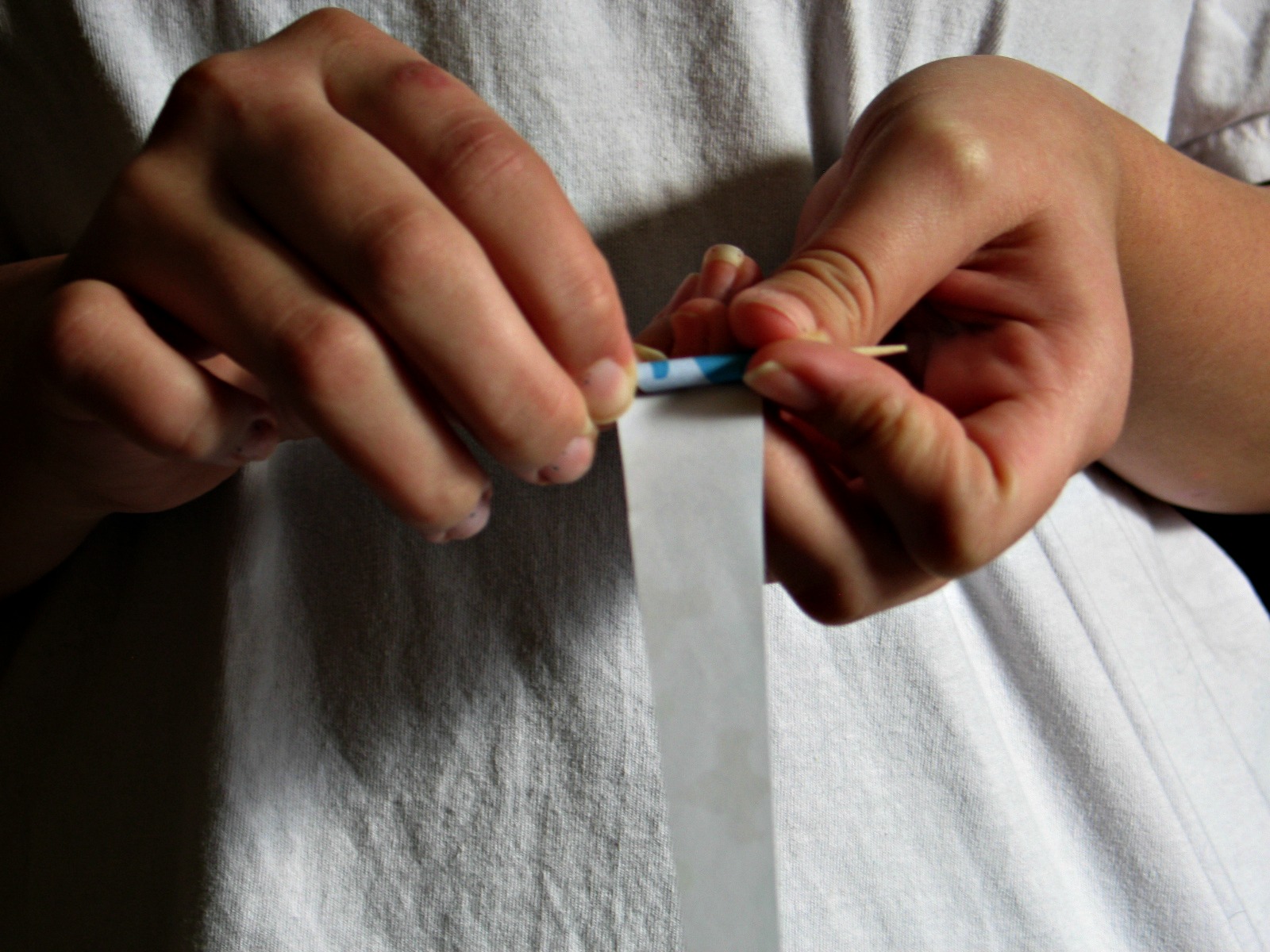
Step 3: Take a thin object----I used a toothpick, but a large needle or smoothed-out paper clip will also work---and wrap the LARGE end of your long, thin triangle around it. Make it nice, even, and tight. Begin rolling the paper, taking care to keep the paper centered. Don't be alarmed if it unrolls repeatedly. Hopefully you will get better as you go along. Let me know if it happens for you---I'm still waiting for it to happen to me!


Step 4: After your paper is all the way rolled, take a little dab of glue and stick down the end of it so it won't unravel. Now slide your bead off and you are ready to make another one.

"Laura picked it up, and it was a beautiful blue bead. Laura shouted for joy.
Then Mary saw a red bead, and Laura saw a green one, and they forgot everything but beads."


Step 5: After the beads are completed, string all of them on some stout wire or string. Make sure it is as wide as whatever you are planning to string them on so the holes don't close off. Paint them with clear varnish---even clear nail polish will do---and let them dry. It will take several coats to get the varnish thick enough.


Step 6: Get your inner designer on and make something gorgeous with your new beads!


I wanted to do a Christmas tree ornament, and had a rough idea in mind. I was inspired by a peacock feather for my color scheme, and I really like how it turned out. But I still don't think you'd look at my ornament and say, "That reminds me of peacock feathers."

I used a variety of sizes, plus I made two pendants by adding another, thinner triangle to the end of my piece to make a really, really long, thin triangle. I also incorporated some clear beads I had on hand.

I can't say enough nice things about this project. It is so fun to take harmless-looking strips of paper and create real beads out of them. And turning them into completed art is even more fun---though I did have to kick my cat out of the "design studio" (read: kitchen) when he wanted to "help."

"The beads made a beautiful string. Carrie clapped her hands and laughed when she saw it. Then Ma tied it around Carrie's little neck, and it glittered there."

So are you ready to see it? My very first paper bead Christmas tree ornament!


Now go make some of your own! You'll have lots of fun and there's no limit to the cool designs you can create---just change the color of the paper to change the color of your beads.

Friday, November 23, 2012

Chapter 13: Texas Longhorns

"One evening Laura and Pa were sitting on the doorstep. The moon shone over the dark prairie, the winds were still, and softly Pa played his fiddle.

He let a last note quiver far, far away, until it dissolved in the moonlight. Everything was so beautiful that Laura wanted it to stay so forever. But Pa said it was time for little girls to go to bed.

Then Laura heard a strange, low, distant sound. "What's that!" she said.

Pa listened. "Cattle, by George!" he said. "Must be the cattle herds going north to Fort Dodge.'"

The next morning when Laura runs out of the house, she sees two men on horseback talking to Pa. Their skin is tanned dark brown and they have flaps of leather over their legs, and spurs, and wide-brimmed hats. Handkerchiefs are knotted around their necks, and pistols are on their hips.

They say, "So long!" to Pa and "Hi! Yip!" to their horses and gallop away.

"Here's a piece of luck!" Pa says to Ma. The cowboys want Pa to help keep the cattle out of the ravines along the creek bluffs. Pa will get a piece of beef for his help. Pa ties his biggest handkerchief around his neck. He shows Laura how it helps to keep the dust from the trail out of his mouth and nose. Then he rides off along the Indian trail.

He is gone all day and comes home at sunset covered with dust. There is dust in his beard and in his hair and on the rims of his eyes. He doesn't have any beef yet, because the cattle aren't all across the creek.

Pa doesn't play the fiddle and goes straight to bed after supper. Laura lies awake, listening to the wailing cowboy songs far away in the night. After everyone else is asleep, Laura creeps to the window and peeks out. She sees three fires glowing against the edge of the land.

The next day, Pa heads off to work again. All day Laura and Mary hear the cattle bawling  and see the dust blowing. Suddenly, a dozen longhorn cattle come rushing up the draw away from the creek. A cowboy on a spotted mustang gallops madly to get in front of them. He waves his big hat and shouts, "Hi! Yi-yi-yi!" as they gallop out of sight.

Laura spends the rest of the afternoon running back and forth, waving her sunbonnet and shouting like a cowboy. Ma finally tells her to stop. It is not ladylike to yell like a cowboy.

Late that afternoon, three riders came out of the west, driving a cow and her little baby. One of the riders is Pa, and he explains that the calf is too little for the journey and the cow is too skinny to sell so the cowboys have given them to Pa.

Ma, Mary, and Laura are so excited and even Baby Carrie laughs for joy. Now they will have milk to drink and butter for their cornbread.

The cow is wild and doesn't want Pa to milk her, but he pushes her against the stable and drives some slabs deep into the ground on the other side. The slabs hold her tight so she can't get away, and Pa milks her. He gets a tin cup almost full of milk.

"Tomorrow I'll build a strong, high yard for the cow, that the wolves can't get into." Pa says.

That night, Baby Carrie enjoys drinking her milk, for they all decide she should have it all. But everyone enjoys the delicious beef steaks and cornbread. As they eat, they listen to the far away songs of the cowboys.

Thoughts:
I already knew from a previous chapter that there are no cows in this area for me to practice milking. OK, there are some wild cows, and that would fit very well with this chapter, but even my bravado quails at the thought of being seen chasing someone's wild beef cattle through a field, trying to milk them.

There are no free-range herds heading through here to the happenin' Canadian cattle markets, so riding the open range wasn't an option either. But, like Laura, I could always embrace the mystique of the lonesome cowboy.

Yes, I would become a cowboy.

Figuratively speaking, of course.

"Laura ran back and forth, waving her sunbonnet and yelling, "Hi! Yi-yi-yi!" till Ma told her to stop. It was not ladylike to yell like that. Laura wished she could be a cowboy."

The first stop on my pathway to cowboy-hood was the thrift store. Cowboys were very thrifty people, after all, and wouldn't have felt any shame in wearing someone's cast off duds. You never can tell when someone will randomly decide to unload hundreds of dollars of beautiful Western finery in just the perfect size for you. But you can tell it wasn't today. I did get a couple of cute shirts and a nice jacket, so all was not lost.

Then I moved on to a fancy-shmancy high-end department store. Yes, I'm talking about Penney's. I haven't bought a new-from-the-store pair of jeans for myself in over 5 years, and when I did, they were always from Walmart. A real cowboy doesn't skimp in the jeans department---cheap jeans have brought out the yodel in more than one hapless son of the range. I was going high quality all the way, baby!

Evidently, in my years of absence from the jean market, it has gotten---ahem--a tad more difficult to find a pair that fits my girlish figure. To save my readers from the trauma I had to endure, I am including a handy field guide to the Language of Jeans.

Low-rise: You'll put the "muffin" in muffin-top, girlfriend!

Boot cut: Made for a giraffe. I'm more along the lines of a pygmy horse.

Flattering fit: If you're a Brazilian super-model. If you're not, don't bother.

Skinny jeans: Free humiliation with every purchase!

Attractive embroidery and design: Will only appear on low-rise or skinny jeans. Those of you shaped like normal people are out of luck.

I should also include a little warning about fitting room mirrors. Don't look in them. Just don't.

It was challenging, but flinty determination is a fitting character trait for any cowboy. I persevered and walked out of there with a pair of jeans I didn't absolutely hate. Score one for me. Now, on to boot shopping.

I'd like to think that back in the old days things weren't quite as expensive, but they probably were. Every part of your wardrobe served an important function, and in the right circumstances could make the difference between life and death. Boot were made by hand, and made to last. I'd priced boots before, so I was a little prepared, but nothing truly readies you for the sensation of staring down at a *gasp* $150 price tag for fancy feet boxes.

I shopped at a couple different stores. I went to the store with the biggest selection first, but didn't really find a pair I really loved. For *gasp* $150 dollars, I want a torrid passion. I finally picked a pair, but they just left me feeling "meh". The boots were pretty, but didn't pop like I wanted them to, so after I bought them, I decided to look at one more store.

The second store had only a couple of pairs in the style I was looking for. But both of them were absolutely gorgeous. I finally picked the one that was a little wider in the leg, since for *gasp* $150 I expected to get quite a bit of mileage out of them (think "Ya-ya Sisterhood of the Traveling Boots") and not everyone has my shapely (read: scrawny) legs.


I also picked up a cowboy hat there, because no cowboy would be caught out on the open trail without his hat. The sun was brutal, and if you lost your hat, you might be forced into wearing----oh, the horror---a sunbonnet. Besides, I looked cute in it.


The next day was picture day! Time to get all dressed up in my duds and put on my best Giddyup. My mom and sister each had an outfit, and we all planned to share the boots around for our portraits. The setting was a rustic barn just outside of town----I arrived just after my mom and sister.

"I see by your outfit that you are a cowboy."

"I see by your outfits that you are cowboys, too."

(It's a Smothers Brothers joke...you had to be there)

Then we got down to the serious business of looking beautiful. At our age, it takes some fierce focusing to pull it off!


It was lots of fun getting to be the Montanan version of a princess for the day. I'm not the type that does the whole "getting fixed up and going out" thing very much, so I really enjoyed shucking off my work-a-day persona for a couple hours. And I got to do it without the actual inconveniences of the real cowboy experience.


Dust, bugs, saddle sores. You can keep them.

I'll just stand around looking cute.

Friday, November 16, 2012

Chapter 12: Fresh Water to Drink


"Next morning Pa marked a large circle in the grass near the corner of the house. With his spade he cut the sod inside the circle, and lifted it up in large pieces. Then he began to shovel out the earth, digging himself deeper and deeper down."

Pa needs to make his trip to town, but before he can go, he must dig a well so Ma will have fresh water while he is gone. Pa cuts the circle into the earth and begins to dig and dig. Laura and Mary must not go near the edge of the well while Pa is digging, but they can see the shovelfuls of dirt that he throws up over the edge.

At last the well is so deep Pa can't throw the dirt high enough to reach the top. He will have to have help from here, so he takes his gun and rides Patty over to Mr. Scott's house to ask him to lend a hand. The next morning at sunup, Mr. Scott arrives to help.

Pa and Mr. Scott make a windlass over the well. It has a handle that turns, and one bucket goes down, and one bucket comes up. They take turns going down into the well to dig; in the morning Mr. Scott digs, and in the afternoon it's Pa's turn.

Every morning before Mr. Scott goes down into the well, Pa sends down a lighted candle. As long as the flame stays lit, Pa knows it is safe to breathe at the bottom. Mr. Scott thinks it's a bunch of nonsense, and one morning, when he arrives before Pa is outside, he begins work without checking the air.

Ma, Laura, and Mary are working in the house when they hear Pa shout, "Scott! Scott!" Then he calls, "Caroline, come quick!"

Ma runs to where Pa is tying the rope firmly around the windlass. He is going after Mr. Scott, who has fainted at the bottom of the well.

"No, Charles! Don't," Ma begs.

"We can't just let him die down there. I won't breathe until I get out."

Ma begs some more, but Pa is firm. He swings into the well and slides out of sight.

After what seems like a very long time, Ma pulls at the windlass and Pa comes up out of the well, hand-over-hand. He climbs out of the well and sits on the ground. Ma sends Laura for some water, and when she gets back, Pa and Ma are both turning the windlass. Slowly the other bucket comes up and Laura sees Mr. Scott slumped over the bucket.

Pa pulls Mr. Scott out onto the grass. He feels Mr. Scott's wrist and listens to his heart. "He's breathing," Pa says.

Pa and Mr. Scott take it easy the rest of the day. The next morning, Pa takes Laura out to the well. He drops some gun powder into the well and lights it. There is a muffled bang and smoke comes up out of the hole. "There, that will drive the gas out of the hold," Pa says.

It takes many more days of digging, but finally there is water in the bottom of the well. When the water comes in Pa almost gets sucked into the muddy slime, and he has to climb out quickly. Soon the well fills with fresh, clean water. Pa makes a strong wooden cover to go over the hole, and Laura and Mary are told they must never touch it. But whenever they are thirsty, Ma lifts the cover and draws a dripping bucket of cool water from the well.

Thoughts:
Gather round, children. It's time for family fun with methane! Oh goody!

Sadly, in the complete absence of volunteers lining up to be nearly suffocated, (I'll just take you to the brink. I promise!) I was forced to look elsewhere for inspiration. It wasn't hard to find; I only had to go as far as the real hero of the story----the lowly candle.

It was the candle that kept everyone safe, and it was in failing to use the candle that Mr. Scott found his life in danger. Candles must have oxygen to burn, and if the well-pit was full of gas, the candle would be snuffed out. Much cheaper than a canary, and not as cruel. Pa Ingalls, the first animal rights activist.

I had a bag of wax shavings that someone gave me, but I was missing a few other key ingredients. Like wicks and something to melt the wax in. In looking up candle making online, I was strictly warned never, NEVER to melt wax without a thermometer. It's best to have a special kettle with the thermometer built in, but at least have a good candy thermometer to avoid over-heating the wax. Which will then burst into flames.

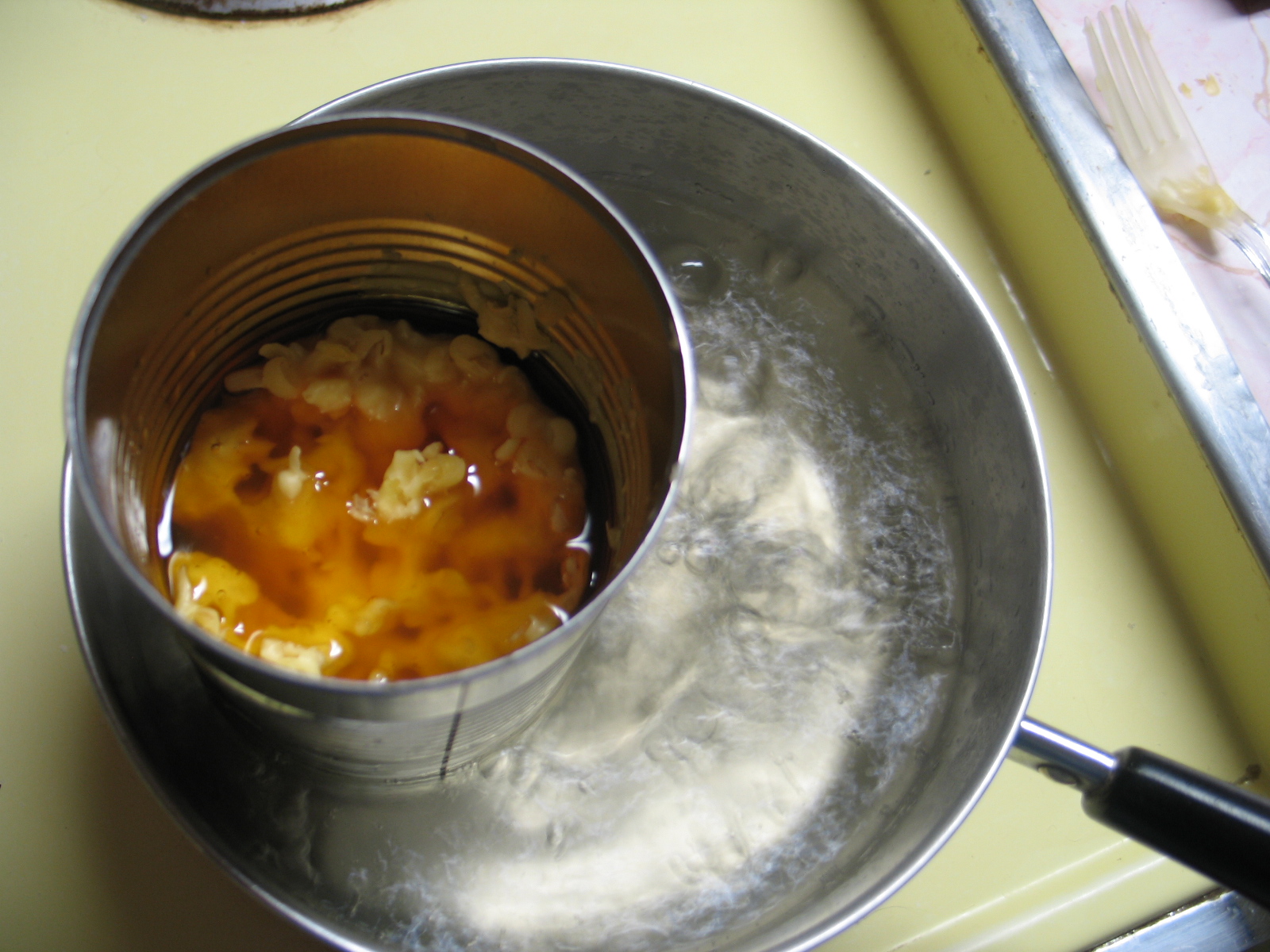
Well, no candy thermometer, and I'm pretty sure that Campbell's soup cans don't come with thermometers built in. But at least I used a double boiler!

Ssh, don't tell anyone, but I got the wick from breaking open a 12" taper I already had. I could have tried to make my own, but I didn't have any Borax on hand. That's my story and I'm sticking to it.


I began melting the wax at a very low temperature since I was paranoid it was going to burst into flames at the first opportunity. Which it didn't. It didn't even melt, really, besides forming a gloppy mass in the bottom of the can.

Building a log cabin would have been faster. It was time to bring the heat.


Once I turned up the heat to a decent level, the water started boiling and the wax started to melt.


When everything was melted I began the tedious process of dipping the wick into the wax. It was even more tedious than usual because for a while I forgot the important step of dipping the candle in water between each dunking. Because the wax was staying hot, it just slid off each time I dipped it again.

I hadn't done this since summer camp about 20 years ago, OK!


After I started cooling the candle each time I dipped it, the wax started accumulating very quickly. "Very quickly" being a relative term....as in quicker than knitting the Taj Mahal with your teeth.


Ah! Done at last. Sure, the candles could have been a bit bigger, but who wants over-weight candles, anyway? I like my candles slim and delicate. Ethereal, almost.

Since I still had quite a bit of wax in the can, I decided to make a snow candle. It was just for fun, since I didn't have a wick to put in it, but I wanted to see what it would turn out like.

Not good.

Evidently, you're supposed to dig a hole in the snow before you pour the wax.


 Well, now I'll know for next time. In the meantime, my parents have some lovely yellow snow in their front yard! I'm sure they'll be thanking me any time now.

"Every morning, before Pa would let Mr. Scott go down the rope, he set a candle in a bucket and lighted it and lowered it to the bottom. Once Laura peeped over the edge and she saw the candle brightly burning, far down in the dark hole in the ground. 

Then Pa would say, "Seems to be all right," and he would pull up the bucket and blow out the candle."

Time to take the candle for a test drive. Was the air in our house fit to breathe? Well, that's debatable in any house inhabited by a teenage boy, but the candle burned, so I guess the air hasn't gotten too rank yet.


You never could have proved it by me....

Thursday, October 25, 2012

Chapter 11: Indians in the House


"Mary! Look!" Laura cried. Mary looked and saw them, too.


They were tall, thin, fierce-looking men. Their skin was brownish-red. Their heads seemed to go up to a peak, and the peak was a tuft of hair that stood straight up and ended in feathers. Their eyes were black and still and glittering, like snake's eyes.

They came closer and closer. Then they went out of sight, on the other side of the house."

Pa is ready to make the bedstead when Ma tells him they are out of meat for dinner. So he leans the wood against the wall, takes his gun, and heads out across the prairie. Poor Jack is tied up so he can't tag along and spoil the hunting.

Laura and Mary feel very sorry for Jack, but Pa told them not to let him off the chain. They spend the morning out petting him and trying to make him feel better, but Jack is too sad. But suddenly Jack stands up with a fierce growl, the hair on his neck standing straight up.

Laura looks over her shoulder and sees two Indians approaching. They walk by the girls and go to the other side of the cabin. Laura and Mary wait for them to pass by the other side, but when they don't reappear, the girls realize that the Indians are in the cabin with Ma and Baby Carrie.

Laura wants to do something to help Ma, and she is about to let Jack off the chain when Mary reminds her that Pa said not to.

"But Pa didn't know the Indians would come...." Laura argues.

"He said not to," said Mary, almost crying.

It is hard, but Laura knows she must obey Pa, even though she is scared. The two girls know they must help Ma, so they run across the yard and slip into the house. Laura runs towards Ma, but then she smells a horrible smell and sees the Indians. She ducks behind the wood that Pa had left leaning against the wall.

From there she can watch the Indians as they quietly eat the cornbread Ma had made them. She sees that they are wearing black and white striped animal skins around their waists. Laura knows those are skunk skins. That is what is making the smell.

After the Indians have eaten, they say something to Ma in their own language and softly walk out of the cabin on their bare feet. Ma lets out a big sigh and hugs Laura and Mary.

When Pa comes home he has a rabbit and two prairie hens for dinner. He skins the rabbit and tells the girls he will salt the pelt and peg it to the side of the house. Then a lucky little girl would get a warm fur hat for winter.

During dinner, everyone tells Pa about their adventure. Laura says that if they had turned Jack loose, he would have eaten those Indians right up. Pa turns to Laura and says in a dreadful voice, "Did you even think of letting Jack loose?"

Laura can't speak, but Mary pipes up, "Yes, Pa."

Pa sighs and says to the girls in a terrible voice, "After this you girls remember to always do as you're told. Don't you even think of disobeying me. Do you hear?"

"Yes, Pa." Laura and Mary whisper.

Thoughts:
First of all, let me clarify that it is not my intention to slur any race in this chapter. While it is written from Laura's perspective, a young, impressionable white girl, I am sure that the native tribes had their own choice descriptions to make about the white settlers. In sum, there was a certain lack of political correctness on both sides of the aisle in those days.

Now that I've got that out of the way....I read this chapter with growing horror at the obvious project. Of course, I could have taken the easy way out and made corn bread, but you can't take a chapter this exciting and turn it into a corn bread recipe.

No, the natural project would be to skin a skunk.

I wouldn't even have to kill one myself, because it is the time of year when a young skunk's thoughts turn to love, and the roads are littered with unlucky romantic swains and swainlets. But could I sacrifice so much, even for my literary dedication?


As it turns out, no.

There are limits, even for me, and smelling like a skunk for several weeks is well within the limits of "Ain't Gonna Happen". So the next best thing I could think of was to find a friendly taxidermist and skin something else.

I searched around a little bit. We are in a heavy hunting area, so there are a few guys to choose from, but each one had his own niche. The first one I talked to only does skulls anymore. Well, that was no help to my mission, but he gave me the name of a man in Dagmar who does other taxidermy work.

I called Ralph Summers up and found that he doesn't do skins anymore either, but he still does head mounts. To do a head mount, you have to prepare the head and shoulders of the animal the same way as any animal skin, and he just so happened to have a couple of deer skins that he was going to be working on the very next day.

"'Come on, Mary and Laura!" Pa said. "We'll skin that rabbit and dress the prairie hens while that cornbread bakes. Hurry! I'm hungry as a wolf."

They sat on the woodpile in the wind and sunshine and watched Pa work with his hunting knife. The big rabbit was shot through the eye, and the prairie hens' heads were shot clean away. They never knew what hit them, Pa said."

Alas, the animals had been skinned in the field, so I missed that lovely process, but once in the shop the hide had to be cleaned. All the fat and muscle had to be trimmed off with a knife and the the last, tiny pieces had to be scraped off with a scalpel. You can use a draw knife to clean the hide, but Mr. Summers prefers the knife and scalpel method.

Tiggy was so fortunate to be available as my assistant. She's been bugging me about being a guest helper on this blog, but I'm not sure she expected her debut to be on "Taxidermy Day". Que sera, sera. Be careful what you wish for.

Holding a salted hide.
We arrived at his shop and were greeted warmly by Mr. Summers, a gracious host who took the time to answer all my questions. Taxidermy is a very interesting, albeit disgusting, process. The steps are pretty basic. An animal is skinned, then the hide is prepared by cleaning it thoroughly and salting the hide to aid in drying.

Back from the tannery.
Then it is sent off to a professional tannery. The happy people at the tannery get to use all the smelly, gross chemicals, and you get a nice, soft hide back in the mail. The taxidermist fits the hide to a pre-made Styrofoam form, making sure to reunite the right antlers back with the right deer.

Voila! A beautiful deer mount ready to be the bane of some wife's existence.

The finished work.
It's a nice, clean process for the hunter. After the initial skinning (and let's face it, if you're going to hunt and eat stuff, you're not that squeamish), he doesn't see it again until it's respectably hanging on the wall, staring at him with a glassy, slightly-reproachful gaze. But the middle stages are not so pretty. I know this.


Yes, that's me. Aproned up in protective gear covered with bits and pieces of a previous badger, according to my host. I brought my own gloves, thank you very much. This vegetarian prefers to keep blood and guts at a distance. I'm holding a very sharp, very business-like knife that is used to trim the fat and muscle from a skin. If you're Mr. Summers, that is. For me, it's used to hack comically and ineffectively at the unyielding flesh.

But I'm getting ahead of myself. First a video where our experienced host demonstrates the art of fleshing. So quick. So easy.


"Laura held the edge of the rabbit skin while Pa's keen knife ripped it off the rabbit meat. "I'll salt this skin and peg it out on the house wall to dry," he said. "It will make a warm fir cap for some little girl to wear next winter.'"

Not so with me, my little friend. I was afraid of slicing through the skin and making a hole in someone's prize deer skin, but I needn't have worried. That knife wasn't going anywhere for me. It didn't help that I was completely grossed out by the cold, clammy, stretchy dead thing in front of me.


Tiggy did a little better than I did, but she was still pathetic compared to our host's example. I guess there is something to be said for 30 years of experience working with everything from reindeer to African Cape Buffalo.

After the first, rough cleaning of a skin, you get to the finer work. I didn't actually work with the scalpel. Somehow, after watching me flail away with the big knife, Mr. Summers failed to offer me a chance with the scalpel. But we did get to see the skin he was trimming up. It gets completely turned inside out. Did you know that deers' ears can turn inside out? Well, they can, and it is a very unattractive look, let me assure you.

From this.....
To this......
So, will I ever become a taxidermist? I'm a big believer in "never say 'never'", but I would predict the chances are pretty low. This veggie eater is glad to live in an era where flesh-free eating is both possible and practical. But I suppose I would have survived chowing down on furry little animals back then if I'd had to.

Maybe.

Thursday, October 18, 2012

Chapter 10: A Roof and a Floor


"Pa had taken the canvas wagon-top off the house, and now he was ready to put the roof on. For days and days, he had been hauling logs from the creek bottoms and splitting them into thin, long slabs. Piles of slabs lay all around the house and slabs stood against it."


Laura and Mary are busy every day; they are never bored. After they help with chores, they hurry into the tall, tall grass to hunt for birds' nests. They see prairie chickens running here and there, and slithering grass snakes hunting for mice. Sometimes they find soft gray rabbits huddled perfectly still in the grass. And all the time they are minding Baby Carrie so Ma can do her work. No, there is never time to be bored on the prairie.

Pa is busy, too. He is beginning the roof of the little log cabin. He begins at the bottom edge of the roof and fits a slab over the rafters, then fastens it to the roof using real iron nails that Mr. Edwards has loaned him. Nails are very precious, and if one of them jumps out of its hole and sails through the air, Mary and Laura watch until it falls. Then they must search the grass until they find it.

One by one the slabs are hammered on until the whole roof is finished. Pa makes a little trough from two slabs and covers the peak of the roof. Now no rain can get in and they are snug and warm. It is time to make the floor.

Pa splits each log down the middle using his ax and wedge to drive a long crack the length of the log. After all the logs are split, Pa drags them into the house and lays them split side up. He uses his shovel and hollows the dirt out so the round side of each log fits firmly into the ground.

He uses the head of his ax and makes little, careful chops to smooth out any rough places on the wood. It takes a long time, but when he is finished the wood is smooth with no splinters to hurt little feet. Ma tells Pa she is glad to be off the dirt and puts a nice, red table cloth on the wood table Pa had made her.

The last thing Pa does is chink all the cracks between the logs. He fills them with thin strips of wood and then plasters them with mud. No wind can blow through those thick, warm logs and Pa, Ma, Mary, Laura, and Baby Carrie are ready for winter.

Thoughts:
Hmmmmm. Putting in a roof and a floor. Fortunately for me, though unfortunately for this blog, my house came complete with roof and floor. There's no time for me to build a roofless cabin, so I had to improvise. Thankfully, my roof is not without its....er....problems in need of repair.

Actually, my whole roof needs to be replaced, but the finances say that won't happen for a year or two (or three or twenty). But there were a couple spots where the shingles had completely blown off the rafters. I could have gone all Polyanna and tried to convince myself that they were skylights, but I'm kind of a diva that way. I actually want my roof to keep out the blizzards, not welcome them in.

The area to be repaired was about 3'x4', and close enough to the edge of the roof that I could just stand on the ladder for the repairs. Good news, because that meant I didn't have to try and get any scaffolding up there. But it would have been nice to have a solid platform under me. Have I mentioned I don't really like heights?

Actually, I don't have a problem with heights as long as I stay in them. It's that rapid descent from them that I have a problem with.

It actually looks much higher in person.
 My dad came out to supervise, because this may surprise you, but I don't actually know what I'm doing when it comes to roofs. My dad would do great in quality control, because if it ain't done right, you're gonna do it again.

Under his supervision, the first step was to fasten a piece of tar paper over the roof-less section. First, I used liquid tar to stick it down around the edges. Liquid tar is a very messy substance that sticks to everything, except possibly your roof. But it is very important, and in spite of its messy nature, it is used everywhere. I ended up with tar on my fingers, tar on the ladder, tar on my clothes, tar all over the ground, and tar my dad's nail gun. I even ended up with tar on my dad, a fact that was not received well by Mr. I-Can-Do-All-This-Without-Making-a-Mess.

"Pa reached down and pulled up a slab. He laid it across the ends of the sapling rafters. Its edge stuck out beyond the wall. Then Pa put some nails in his mouth and took his hammer out of his belt, and he began to nail the slab to the rafters."

Then I got to use the nail gun to tack down the tar paper and put on the shingles. Using the nail gun is exciting because it has a hair trigger. As you stretch out to the limits of your reach (because you are short and shrimpy), and gingerly squeeze the trigger while trying to stay balanced on top of your ladder, it gives you quite a thrill to have 3 or 4 nails shoot out with a noise like a machine gun. Under the circumstances, screaming can be helpful to relieve feelings.

After the tar paper was down, it was time to put on the shingles. Shingling is pretty fun. You glop your shingle up with tar, then plop it on the roof and nail it down with the nail gun. It's important to alternate the pattern of shingles so you don't end up with straight lines going up. It's also important to stick the edges down well with tar, especially around here where 95% of the year is hurricane season.

"The roof was done. The house was darker than it had been, because no light came through the slabs. There was not one single crack that would let rain come in."

My repair job turned out pretty nicely, if I do say so myself. I even did a couple of spots on the other side of the house once my dad left, but without my quality control inspector here they didn't turn out quite as nicely. In my defense, it was starting to rain, and the wind was starting to blow a lot harder. Not a good time to be up on a ladder, especially when---did I mention it?---I'm not very fond of heights.

"There," Ma said. "Now we're living like civilized folks again."

Just like the Ingalls' house, my home is really starting to come together now. Of course, it's been almost 2 years since I moved in, not one short summer season, but in my defense I have to be both Pa and Ma to my family. That does make things take a little longer. But I can still identify with the thrill of accomplishment that comes from making things better with your own hands. People who can afford to simply hire someone to do their work are sure missing out on a lot---a lot of blisters and aching muscles, true, but also a sense of competence and confidence that no amount of money can buy.