Friday, November 23, 2012

Chapter 13: Texas Longhorns

"One evening Laura and Pa were sitting on the doorstep. The moon shone over the dark prairie, the winds were still, and softly Pa played his fiddle.

He let a last note quiver far, far away, until it dissolved in the moonlight. Everything was so beautiful that Laura wanted it to stay so forever. But Pa said it was time for little girls to go to bed.

Then Laura heard a strange, low, distant sound. "What's that!" she said.

Pa listened. "Cattle, by George!" he said. "Must be the cattle herds going north to Fort Dodge.'"

The next morning when Laura runs out of the house, she sees two men on horseback talking to Pa. Their skin is tanned dark brown and they have flaps of leather over their legs, and spurs, and wide-brimmed hats. Handkerchiefs are knotted around their necks, and pistols are on their hips.

They say, "So long!" to Pa and "Hi! Yip!" to their horses and gallop away.

"Here's a piece of luck!" Pa says to Ma. The cowboys want Pa to help keep the cattle out of the ravines along the creek bluffs. Pa will get a piece of beef for his help. Pa ties his biggest handkerchief around his neck. He shows Laura how it helps to keep the dust from the trail out of his mouth and nose. Then he rides off along the Indian trail.

He is gone all day and comes home at sunset covered with dust. There is dust in his beard and in his hair and on the rims of his eyes. He doesn't have any beef yet, because the cattle aren't all across the creek.

Pa doesn't play the fiddle and goes straight to bed after supper. Laura lies awake, listening to the wailing cowboy songs far away in the night. After everyone else is asleep, Laura creeps to the window and peeks out. She sees three fires glowing against the edge of the land.

The next day, Pa heads off to work again. All day Laura and Mary hear the cattle bawling  and see the dust blowing. Suddenly, a dozen longhorn cattle come rushing up the draw away from the creek. A cowboy on a spotted mustang gallops madly to get in front of them. He waves his big hat and shouts, "Hi! Yi-yi-yi!" as they gallop out of sight.

Laura spends the rest of the afternoon running back and forth, waving her sunbonnet and shouting like a cowboy. Ma finally tells her to stop. It is not ladylike to yell like a cowboy.

Late that afternoon, three riders came out of the west, driving a cow and her little baby. One of the riders is Pa, and he explains that the calf is too little for the journey and the cow is too skinny to sell so the cowboys have given them to Pa.

Ma, Mary, and Laura are so excited and even Baby Carrie laughs for joy. Now they will have milk to drink and butter for their cornbread.

The cow is wild and doesn't want Pa to milk her, but he pushes her against the stable and drives some slabs deep into the ground on the other side. The slabs hold her tight so she can't get away, and Pa milks her. He gets a tin cup almost full of milk.

"Tomorrow I'll build a strong, high yard for the cow, that the wolves can't get into." Pa says.

That night, Baby Carrie enjoys drinking her milk, for they all decide she should have it all. But everyone enjoys the delicious beef steaks and cornbread. As they eat, they listen to the far away songs of the cowboys.

Thoughts:
I already knew from a previous chapter that there are no cows in this area for me to practice milking. OK, there are some wild cows, and that would fit very well with this chapter, but even my bravado quails at the thought of being seen chasing someone's wild beef cattle through a field, trying to milk them.

There are no free-range herds heading through here to the happenin' Canadian cattle markets, so riding the open range wasn't an option either. But, like Laura, I could always embrace the mystique of the lonesome cowboy.

Yes, I would become a cowboy.

Figuratively speaking, of course.

"Laura ran back and forth, waving her sunbonnet and yelling, "Hi! Yi-yi-yi!" till Ma told her to stop. It was not ladylike to yell like that. Laura wished she could be a cowboy."

The first stop on my pathway to cowboy-hood was the thrift store. Cowboys were very thrifty people, after all, and wouldn't have felt any shame in wearing someone's cast off duds. You never can tell when someone will randomly decide to unload hundreds of dollars of beautiful Western finery in just the perfect size for you. But you can tell it wasn't today. I did get a couple of cute shirts and a nice jacket, so all was not lost.

Then I moved on to a fancy-shmancy high-end department store. Yes, I'm talking about Penney's. I haven't bought a new-from-the-store pair of jeans for myself in over 5 years, and when I did, they were always from Walmart. A real cowboy doesn't skimp in the jeans department---cheap jeans have brought out the yodel in more than one hapless son of the range. I was going high quality all the way, baby!

Evidently, in my years of absence from the jean market, it has gotten---ahem--a tad more difficult to find a pair that fits my girlish figure. To save my readers from the trauma I had to endure, I am including a handy field guide to the Language of Jeans.

Low-rise: You'll put the "muffin" in muffin-top, girlfriend!

Boot cut: Made for a giraffe. I'm more along the lines of a pygmy horse.

Flattering fit: If you're a Brazilian super-model. If you're not, don't bother.

Skinny jeans: Free humiliation with every purchase!

Attractive embroidery and design: Will only appear on low-rise or skinny jeans. Those of you shaped like normal people are out of luck.

I should also include a little warning about fitting room mirrors. Don't look in them. Just don't.

It was challenging, but flinty determination is a fitting character trait for any cowboy. I persevered and walked out of there with a pair of jeans I didn't absolutely hate. Score one for me. Now, on to boot shopping.

I'd like to think that back in the old days things weren't quite as expensive, but they probably were. Every part of your wardrobe served an important function, and in the right circumstances could make the difference between life and death. Boot were made by hand, and made to last. I'd priced boots before, so I was a little prepared, but nothing truly readies you for the sensation of staring down at a *gasp* $150 price tag for fancy feet boxes.

I shopped at a couple different stores. I went to the store with the biggest selection first, but didn't really find a pair I really loved. For *gasp* $150 dollars, I want a torrid passion. I finally picked a pair, but they just left me feeling "meh". The boots were pretty, but didn't pop like I wanted them to, so after I bought them, I decided to look at one more store.

The second store had only a couple of pairs in the style I was looking for. But both of them were absolutely gorgeous. I finally picked the one that was a little wider in the leg, since for *gasp* $150 I expected to get quite a bit of mileage out of them (think "Ya-ya Sisterhood of the Traveling Boots") and not everyone has my shapely (read: scrawny) legs.


I also picked up a cowboy hat there, because no cowboy would be caught out on the open trail without his hat. The sun was brutal, and if you lost your hat, you might be forced into wearing----oh, the horror---a sunbonnet. Besides, I looked cute in it.


The next day was picture day! Time to get all dressed up in my duds and put on my best Giddyup. My mom and sister each had an outfit, and we all planned to share the boots around for our portraits. The setting was a rustic barn just outside of town----I arrived just after my mom and sister.

"I see by your outfit that you are a cowboy."

"I see by your outfits that you are cowboys, too."

(It's a Smothers Brothers joke...you had to be there)

Then we got down to the serious business of looking beautiful. At our age, it takes some fierce focusing to pull it off!


It was lots of fun getting to be the Montanan version of a princess for the day. I'm not the type that does the whole "getting fixed up and going out" thing very much, so I really enjoyed shucking off my work-a-day persona for a couple hours. And I got to do it without the actual inconveniences of the real cowboy experience.


Dust, bugs, saddle sores. You can keep them.

I'll just stand around looking cute.

Friday, November 16, 2012

Chapter 12: Fresh Water to Drink


"Next morning Pa marked a large circle in the grass near the corner of the house. With his spade he cut the sod inside the circle, and lifted it up in large pieces. Then he began to shovel out the earth, digging himself deeper and deeper down."

Pa needs to make his trip to town, but before he can go, he must dig a well so Ma will have fresh water while he is gone. Pa cuts the circle into the earth and begins to dig and dig. Laura and Mary must not go near the edge of the well while Pa is digging, but they can see the shovelfuls of dirt that he throws up over the edge.

At last the well is so deep Pa can't throw the dirt high enough to reach the top. He will have to have help from here, so he takes his gun and rides Patty over to Mr. Scott's house to ask him to lend a hand. The next morning at sunup, Mr. Scott arrives to help.

Pa and Mr. Scott make a windlass over the well. It has a handle that turns, and one bucket goes down, and one bucket comes up. They take turns going down into the well to dig; in the morning Mr. Scott digs, and in the afternoon it's Pa's turn.

Every morning before Mr. Scott goes down into the well, Pa sends down a lighted candle. As long as the flame stays lit, Pa knows it is safe to breathe at the bottom. Mr. Scott thinks it's a bunch of nonsense, and one morning, when he arrives before Pa is outside, he begins work without checking the air.

Ma, Laura, and Mary are working in the house when they hear Pa shout, "Scott! Scott!" Then he calls, "Caroline, come quick!"

Ma runs to where Pa is tying the rope firmly around the windlass. He is going after Mr. Scott, who has fainted at the bottom of the well.

"No, Charles! Don't," Ma begs.

"We can't just let him die down there. I won't breathe until I get out."

Ma begs some more, but Pa is firm. He swings into the well and slides out of sight.

After what seems like a very long time, Ma pulls at the windlass and Pa comes up out of the well, hand-over-hand. He climbs out of the well and sits on the ground. Ma sends Laura for some water, and when she gets back, Pa and Ma are both turning the windlass. Slowly the other bucket comes up and Laura sees Mr. Scott slumped over the bucket.

Pa pulls Mr. Scott out onto the grass. He feels Mr. Scott's wrist and listens to his heart. "He's breathing," Pa says.

Pa and Mr. Scott take it easy the rest of the day. The next morning, Pa takes Laura out to the well. He drops some gun powder into the well and lights it. There is a muffled bang and smoke comes up out of the hole. "There, that will drive the gas out of the hold," Pa says.

It takes many more days of digging, but finally there is water in the bottom of the well. When the water comes in Pa almost gets sucked into the muddy slime, and he has to climb out quickly. Soon the well fills with fresh, clean water. Pa makes a strong wooden cover to go over the hole, and Laura and Mary are told they must never touch it. But whenever they are thirsty, Ma lifts the cover and draws a dripping bucket of cool water from the well.

Thoughts:
Gather round, children. It's time for family fun with methane! Oh goody!

Sadly, in the complete absence of volunteers lining up to be nearly suffocated, (I'll just take you to the brink. I promise!) I was forced to look elsewhere for inspiration. It wasn't hard to find; I only had to go as far as the real hero of the story----the lowly candle.

It was the candle that kept everyone safe, and it was in failing to use the candle that Mr. Scott found his life in danger. Candles must have oxygen to burn, and if the well-pit was full of gas, the candle would be snuffed out. Much cheaper than a canary, and not as cruel. Pa Ingalls, the first animal rights activist.

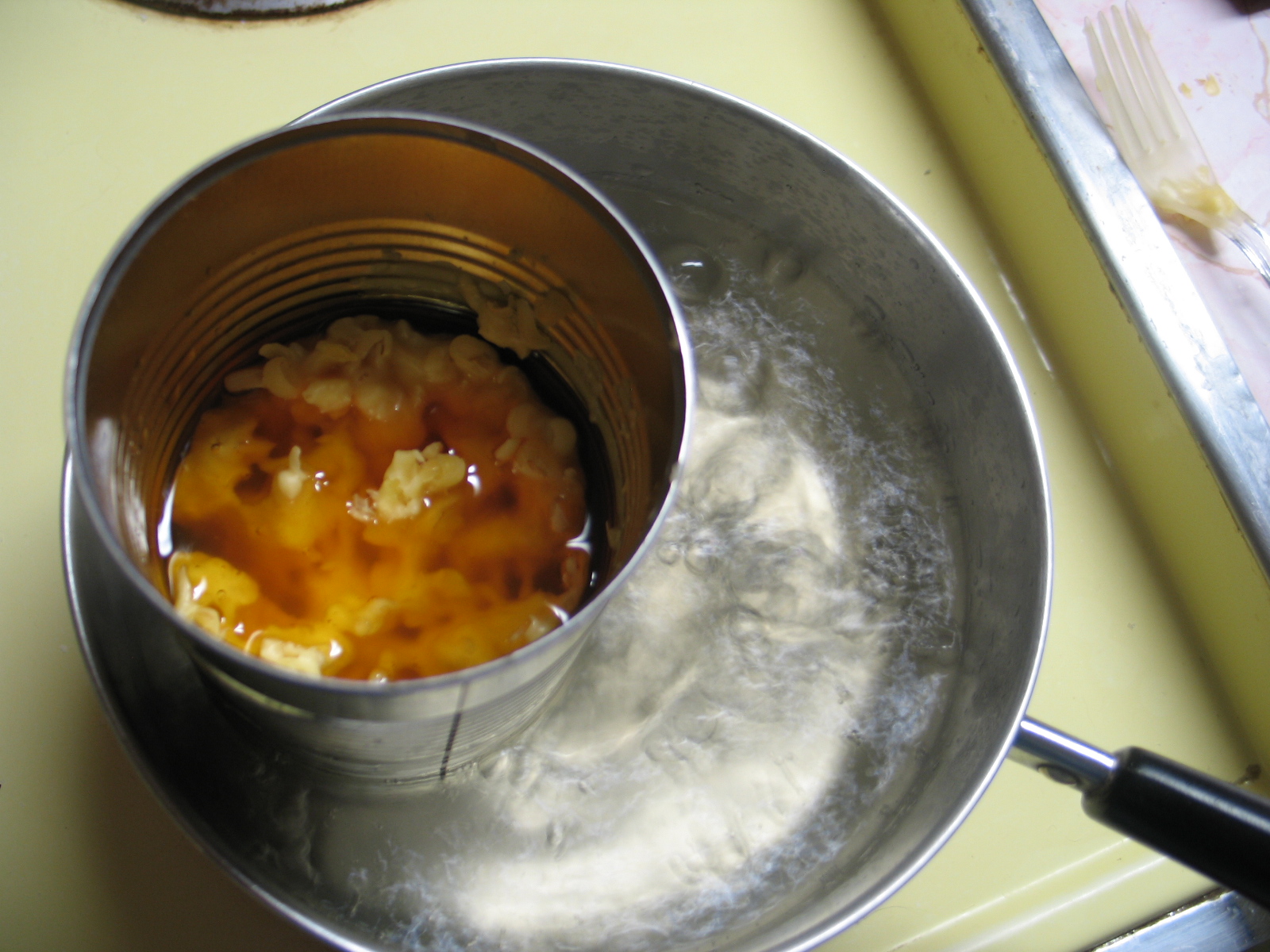
I had a bag of wax shavings that someone gave me, but I was missing a few other key ingredients. Like wicks and something to melt the wax in. In looking up candle making online, I was strictly warned never, NEVER to melt wax without a thermometer. It's best to have a special kettle with the thermometer built in, but at least have a good candy thermometer to avoid over-heating the wax. Which will then burst into flames.

Well, no candy thermometer, and I'm pretty sure that Campbell's soup cans don't come with thermometers built in. But at least I used a double boiler!

Ssh, don't tell anyone, but I got the wick from breaking open a 12" taper I already had. I could have tried to make my own, but I didn't have any Borax on hand. That's my story and I'm sticking to it.


I began melting the wax at a very low temperature since I was paranoid it was going to burst into flames at the first opportunity. Which it didn't. It didn't even melt, really, besides forming a gloppy mass in the bottom of the can.

Building a log cabin would have been faster. It was time to bring the heat.


Once I turned up the heat to a decent level, the water started boiling and the wax started to melt.


When everything was melted I began the tedious process of dipping the wick into the wax. It was even more tedious than usual because for a while I forgot the important step of dipping the candle in water between each dunking. Because the wax was staying hot, it just slid off each time I dipped it again.

I hadn't done this since summer camp about 20 years ago, OK!


After I started cooling the candle each time I dipped it, the wax started accumulating very quickly. "Very quickly" being a relative term....as in quicker than knitting the Taj Mahal with your teeth.


Ah! Done at last. Sure, the candles could have been a bit bigger, but who wants over-weight candles, anyway? I like my candles slim and delicate. Ethereal, almost.

Since I still had quite a bit of wax in the can, I decided to make a snow candle. It was just for fun, since I didn't have a wick to put in it, but I wanted to see what it would turn out like.

Not good.

Evidently, you're supposed to dig a hole in the snow before you pour the wax.


 Well, now I'll know for next time. In the meantime, my parents have some lovely yellow snow in their front yard! I'm sure they'll be thanking me any time now.

"Every morning, before Pa would let Mr. Scott go down the rope, he set a candle in a bucket and lighted it and lowered it to the bottom. Once Laura peeped over the edge and she saw the candle brightly burning, far down in the dark hole in the ground. 

Then Pa would say, "Seems to be all right," and he would pull up the bucket and blow out the candle."

Time to take the candle for a test drive. Was the air in our house fit to breathe? Well, that's debatable in any house inhabited by a teenage boy, but the candle burned, so I guess the air hasn't gotten too rank yet.


You never could have proved it by me....

Thursday, October 25, 2012

Chapter 11: Indians in the House


"Mary! Look!" Laura cried. Mary looked and saw them, too.


They were tall, thin, fierce-looking men. Their skin was brownish-red. Their heads seemed to go up to a peak, and the peak was a tuft of hair that stood straight up and ended in feathers. Their eyes were black and still and glittering, like snake's eyes.

They came closer and closer. Then they went out of sight, on the other side of the house."

Pa is ready to make the bedstead when Ma tells him they are out of meat for dinner. So he leans the wood against the wall, takes his gun, and heads out across the prairie. Poor Jack is tied up so he can't tag along and spoil the hunting.

Laura and Mary feel very sorry for Jack, but Pa told them not to let him off the chain. They spend the morning out petting him and trying to make him feel better, but Jack is too sad. But suddenly Jack stands up with a fierce growl, the hair on his neck standing straight up.

Laura looks over her shoulder and sees two Indians approaching. They walk by the girls and go to the other side of the cabin. Laura and Mary wait for them to pass by the other side, but when they don't reappear, the girls realize that the Indians are in the cabin with Ma and Baby Carrie.

Laura wants to do something to help Ma, and she is about to let Jack off the chain when Mary reminds her that Pa said not to.

"But Pa didn't know the Indians would come...." Laura argues.

"He said not to," said Mary, almost crying.

It is hard, but Laura knows she must obey Pa, even though she is scared. The two girls know they must help Ma, so they run across the yard and slip into the house. Laura runs towards Ma, but then she smells a horrible smell and sees the Indians. She ducks behind the wood that Pa had left leaning against the wall.

From there she can watch the Indians as they quietly eat the cornbread Ma had made them. She sees that they are wearing black and white striped animal skins around their waists. Laura knows those are skunk skins. That is what is making the smell.

After the Indians have eaten, they say something to Ma in their own language and softly walk out of the cabin on their bare feet. Ma lets out a big sigh and hugs Laura and Mary.

When Pa comes home he has a rabbit and two prairie hens for dinner. He skins the rabbit and tells the girls he will salt the pelt and peg it to the side of the house. Then a lucky little girl would get a warm fur hat for winter.

During dinner, everyone tells Pa about their adventure. Laura says that if they had turned Jack loose, he would have eaten those Indians right up. Pa turns to Laura and says in a dreadful voice, "Did you even think of letting Jack loose?"

Laura can't speak, but Mary pipes up, "Yes, Pa."

Pa sighs and says to the girls in a terrible voice, "After this you girls remember to always do as you're told. Don't you even think of disobeying me. Do you hear?"

"Yes, Pa." Laura and Mary whisper.

Thoughts:
First of all, let me clarify that it is not my intention to slur any race in this chapter. While it is written from Laura's perspective, a young, impressionable white girl, I am sure that the native tribes had their own choice descriptions to make about the white settlers. In sum, there was a certain lack of political correctness on both sides of the aisle in those days.

Now that I've got that out of the way....I read this chapter with growing horror at the obvious project. Of course, I could have taken the easy way out and made corn bread, but you can't take a chapter this exciting and turn it into a corn bread recipe.

No, the natural project would be to skin a skunk.

I wouldn't even have to kill one myself, because it is the time of year when a young skunk's thoughts turn to love, and the roads are littered with unlucky romantic swains and swainlets. But could I sacrifice so much, even for my literary dedication?


As it turns out, no.

There are limits, even for me, and smelling like a skunk for several weeks is well within the limits of "Ain't Gonna Happen". So the next best thing I could think of was to find a friendly taxidermist and skin something else.

I searched around a little bit. We are in a heavy hunting area, so there are a few guys to choose from, but each one had his own niche. The first one I talked to only does skulls anymore. Well, that was no help to my mission, but he gave me the name of a man in Dagmar who does other taxidermy work.

I called Ralph Summers up and found that he doesn't do skins anymore either, but he still does head mounts. To do a head mount, you have to prepare the head and shoulders of the animal the same way as any animal skin, and he just so happened to have a couple of deer skins that he was going to be working on the very next day.

"'Come on, Mary and Laura!" Pa said. "We'll skin that rabbit and dress the prairie hens while that cornbread bakes. Hurry! I'm hungry as a wolf."

They sat on the woodpile in the wind and sunshine and watched Pa work with his hunting knife. The big rabbit was shot through the eye, and the prairie hens' heads were shot clean away. They never knew what hit them, Pa said."

Alas, the animals had been skinned in the field, so I missed that lovely process, but once in the shop the hide had to be cleaned. All the fat and muscle had to be trimmed off with a knife and the the last, tiny pieces had to be scraped off with a scalpel. You can use a draw knife to clean the hide, but Mr. Summers prefers the knife and scalpel method.

Tiggy was so fortunate to be available as my assistant. She's been bugging me about being a guest helper on this blog, but I'm not sure she expected her debut to be on "Taxidermy Day". Que sera, sera. Be careful what you wish for.

Holding a salted hide.
We arrived at his shop and were greeted warmly by Mr. Summers, a gracious host who took the time to answer all my questions. Taxidermy is a very interesting, albeit disgusting, process. The steps are pretty basic. An animal is skinned, then the hide is prepared by cleaning it thoroughly and salting the hide to aid in drying.

Back from the tannery.
Then it is sent off to a professional tannery. The happy people at the tannery get to use all the smelly, gross chemicals, and you get a nice, soft hide back in the mail. The taxidermist fits the hide to a pre-made Styrofoam form, making sure to reunite the right antlers back with the right deer.

Voila! A beautiful deer mount ready to be the bane of some wife's existence.

The finished work.
It's a nice, clean process for the hunter. After the initial skinning (and let's face it, if you're going to hunt and eat stuff, you're not that squeamish), he doesn't see it again until it's respectably hanging on the wall, staring at him with a glassy, slightly-reproachful gaze. But the middle stages are not so pretty. I know this.


Yes, that's me. Aproned up in protective gear covered with bits and pieces of a previous badger, according to my host. I brought my own gloves, thank you very much. This vegetarian prefers to keep blood and guts at a distance. I'm holding a very sharp, very business-like knife that is used to trim the fat and muscle from a skin. If you're Mr. Summers, that is. For me, it's used to hack comically and ineffectively at the unyielding flesh.

But I'm getting ahead of myself. First a video where our experienced host demonstrates the art of fleshing. So quick. So easy.


"Laura held the edge of the rabbit skin while Pa's keen knife ripped it off the rabbit meat. "I'll salt this skin and peg it out on the house wall to dry," he said. "It will make a warm fir cap for some little girl to wear next winter.'"

Not so with me, my little friend. I was afraid of slicing through the skin and making a hole in someone's prize deer skin, but I needn't have worried. That knife wasn't going anywhere for me. It didn't help that I was completely grossed out by the cold, clammy, stretchy dead thing in front of me.


Tiggy did a little better than I did, but she was still pathetic compared to our host's example. I guess there is something to be said for 30 years of experience working with everything from reindeer to African Cape Buffalo.

After the first, rough cleaning of a skin, you get to the finer work. I didn't actually work with the scalpel. Somehow, after watching me flail away with the big knife, Mr. Summers failed to offer me a chance with the scalpel. But we did get to see the skin he was trimming up. It gets completely turned inside out. Did you know that deers' ears can turn inside out? Well, they can, and it is a very unattractive look, let me assure you.

From this.....
To this......
So, will I ever become a taxidermist? I'm a big believer in "never say 'never'", but I would predict the chances are pretty low. This veggie eater is glad to live in an era where flesh-free eating is both possible and practical. But I suppose I would have survived chowing down on furry little animals back then if I'd had to.

Maybe.

Thursday, October 18, 2012

Chapter 10: A Roof and a Floor


"Pa had taken the canvas wagon-top off the house, and now he was ready to put the roof on. For days and days, he had been hauling logs from the creek bottoms and splitting them into thin, long slabs. Piles of slabs lay all around the house and slabs stood against it."


Laura and Mary are busy every day; they are never bored. After they help with chores, they hurry into the tall, tall grass to hunt for birds' nests. They see prairie chickens running here and there, and slithering grass snakes hunting for mice. Sometimes they find soft gray rabbits huddled perfectly still in the grass. And all the time they are minding Baby Carrie so Ma can do her work. No, there is never time to be bored on the prairie.

Pa is busy, too. He is beginning the roof of the little log cabin. He begins at the bottom edge of the roof and fits a slab over the rafters, then fastens it to the roof using real iron nails that Mr. Edwards has loaned him. Nails are very precious, and if one of them jumps out of its hole and sails through the air, Mary and Laura watch until it falls. Then they must search the grass until they find it.

One by one the slabs are hammered on until the whole roof is finished. Pa makes a little trough from two slabs and covers the peak of the roof. Now no rain can get in and they are snug and warm. It is time to make the floor.

Pa splits each log down the middle using his ax and wedge to drive a long crack the length of the log. After all the logs are split, Pa drags them into the house and lays them split side up. He uses his shovel and hollows the dirt out so the round side of each log fits firmly into the ground.

He uses the head of his ax and makes little, careful chops to smooth out any rough places on the wood. It takes a long time, but when he is finished the wood is smooth with no splinters to hurt little feet. Ma tells Pa she is glad to be off the dirt and puts a nice, red table cloth on the wood table Pa had made her.

The last thing Pa does is chink all the cracks between the logs. He fills them with thin strips of wood and then plasters them with mud. No wind can blow through those thick, warm logs and Pa, Ma, Mary, Laura, and Baby Carrie are ready for winter.

Thoughts:
Hmmmmm. Putting in a roof and a floor. Fortunately for me, though unfortunately for this blog, my house came complete with roof and floor. There's no time for me to build a roofless cabin, so I had to improvise. Thankfully, my roof is not without its....er....problems in need of repair.

Actually, my whole roof needs to be replaced, but the finances say that won't happen for a year or two (or three or twenty). But there were a couple spots where the shingles had completely blown off the rafters. I could have gone all Polyanna and tried to convince myself that they were skylights, but I'm kind of a diva that way. I actually want my roof to keep out the blizzards, not welcome them in.

The area to be repaired was about 3'x4', and close enough to the edge of the roof that I could just stand on the ladder for the repairs. Good news, because that meant I didn't have to try and get any scaffolding up there. But it would have been nice to have a solid platform under me. Have I mentioned I don't really like heights?

Actually, I don't have a problem with heights as long as I stay in them. It's that rapid descent from them that I have a problem with.

It actually looks much higher in person.
 My dad came out to supervise, because this may surprise you, but I don't actually know what I'm doing when it comes to roofs. My dad would do great in quality control, because if it ain't done right, you're gonna do it again.

Under his supervision, the first step was to fasten a piece of tar paper over the roof-less section. First, I used liquid tar to stick it down around the edges. Liquid tar is a very messy substance that sticks to everything, except possibly your roof. But it is very important, and in spite of its messy nature, it is used everywhere. I ended up with tar on my fingers, tar on the ladder, tar on my clothes, tar all over the ground, and tar my dad's nail gun. I even ended up with tar on my dad, a fact that was not received well by Mr. I-Can-Do-All-This-Without-Making-a-Mess.

"Pa reached down and pulled up a slab. He laid it across the ends of the sapling rafters. Its edge stuck out beyond the wall. Then Pa put some nails in his mouth and took his hammer out of his belt, and he began to nail the slab to the rafters."

Then I got to use the nail gun to tack down the tar paper and put on the shingles. Using the nail gun is exciting because it has a hair trigger. As you stretch out to the limits of your reach (because you are short and shrimpy), and gingerly squeeze the trigger while trying to stay balanced on top of your ladder, it gives you quite a thrill to have 3 or 4 nails shoot out with a noise like a machine gun. Under the circumstances, screaming can be helpful to relieve feelings.

After the tar paper was down, it was time to put on the shingles. Shingling is pretty fun. You glop your shingle up with tar, then plop it on the roof and nail it down with the nail gun. It's important to alternate the pattern of shingles so you don't end up with straight lines going up. It's also important to stick the edges down well with tar, especially around here where 95% of the year is hurricane season.

"The roof was done. The house was darker than it had been, because no light came through the slabs. There was not one single crack that would let rain come in."

My repair job turned out pretty nicely, if I do say so myself. I even did a couple of spots on the other side of the house once my dad left, but without my quality control inspector here they didn't turn out quite as nicely. In my defense, it was starting to rain, and the wind was starting to blow a lot harder. Not a good time to be up on a ladder, especially when---did I mention it?---I'm not very fond of heights.

"There," Ma said. "Now we're living like civilized folks again."

Just like the Ingalls' house, my home is really starting to come together now. Of course, it's been almost 2 years since I moved in, not one short summer season, but in my defense I have to be both Pa and Ma to my family. That does make things take a little longer. But I can still identify with the thrill of accomplishment that comes from making things better with your own hands. People who can afford to simply hire someone to do their work are sure missing out on a lot---a lot of blisters and aching muscles, true, but also a sense of competence and confidence that no amount of money can buy.


Tuesday, September 25, 2012

Chapter 9: A Fire on the Hearth

"Outside the house, close to the log wall opposite the door, Pa cut away the grass and scraped the ground smooth. He was getting ready to build the fireplace.

Then he and Ma put the wagon-box on the wheels again, and Pa hitched up Pet and Patty...Pa was whistling while he climbed to the wagon-seat and took up the reins. Then he looked down at Laura, who was looking up at him, and he stopped whistling and said: "Want to go along, Laura? You and Mary?"

Now that there is a nice, strong door on the cabin, Pa turns his attention to building a fireplace. Ma has been cooking outside in the prairie wind, and Pa wants her to be able to cook in comfort. He prepares the ground for a fireplace, then heads down to the creek bottom to fetch rocks.

Laura and Mary are so excited to be able to go with Pa. They see deer, rabbits, snakes, and squirrels. They play in the warm sun along the creek, chasing frogs and watching minnows dart in and out of the shadows. They see lots of mosquitoes, too, but they don't like them!

At last Pa says they can wade in a very shallow part of the creek. Mary doesn't wade for very long because the pebbles hurt her feet, but Laura wades up and down. The minnows nibble on her toes; Laura tries and tries to catch one, but they always get away.

Then it is time to head back up onto the high prairie. When they get back to the house, Pa unloads the rocks and begins the fireplace. He lays a row of rocks down, then spreads the tops and down the inside with mud. He lays another row of rocks on top and does the same thing again. The walls grow taller and taller until they are as high as the roof.

The next day, Ma suggests that Pa do the rest of the chimney using stick-and-daub. He is glad to follow her suggestion because the rocks were getting very hard to lift to the top of the walls. Soon the chimney is all done, and Pa goes inside and chops out the wall in front of the fireplace. Now there is a large opening, big enough for Laura, Mary, and Carrie to all get inside. The chimney is at the top, the front is the cabin, and the back is the rock wall that Pa built.

That night, Ma cooks supper inside. She is very happy.

Thoughts:
Ooooh, I am so excited! I am finally finishing this chapter and am able to move on. I started this back in the spring, but shipwrecked right at the beginning where Pa prepares the ground by scraping it clean. I mowed a spot to work on my project, but before I could do anything, the grass had grown back already. Spring and summer are very busy times around here, and I've spent the past 5 months chopping the weeds in the same stupid spot, never having the time to actually finish. I felt like a hamster on an exercise wheel!

In reading this chapter, I quickly discarded any thought of building a stone fireplace onto my house or chopping holes in it. Poor thing is already falling down; no need to weaken it further! Outdoor stone masonry was definitely the way to go. I toyed with the idea of building a stone bread oven, but ironically discarded that suggestion because "it would take to long."

I settled on a fire-pit, just the thing for cozy marshmallow roasts and crisp spring fall nights. Like I said, the first thing I did was cut the grass around the area. And then continued that for the next 5 months. Finally, a couple weeks ago things settled down enough that I was able to begin making some new progress.

"Laura and Mary played by the creek, while Pa dug the rocks he wanted and loaded them into the wagon."

Caleb and I started hauling rocks from the many rock piles that litter the fields around here. Years ago, when this land was first broken up for farming, brave pioneers hauled tons of rocks from the fields and piled them here and there across the land. When I first moved here, I was reluctant to touch them without the owner's permission. Turns out there was no need to worry---the farmers just laughed when I asked. It had never occurred to them that someone would want extra rocks, but they certainly didn't mind, if I was crazy enough to want 'em.

When starting a stone project, it helps to keep this rule in mind. Haul 3 times as many rocks as you think you'll need. If you do that, you should have to make only 2 or 3 more trips to get more. Thankfully, we no longer have to use a mule and a stone boat....vans are much easier.

I dug out the circle for the fire-pit. It was difficult to get through the initial layer of matted grass roots; when I tried, I discovered that it peeled back in pieces like the old sod bricks. Maybe I'll have to make myself a soddy after all! The cats LOVED the little circle, with its nice, fresh dirt. They seemed to think I was making it just for them.

"First he mixed clay and water to a beautiful thick mud, in the mustangs' water bucket. He let Laura stir the mud while he laid a row of rocks around three sides of the space he had cleared by the house-wall."

Once the circle was ready and the rocks were hauled, it was time to go get the mud. Of course I headed down to the flooded road, an excellent source for all things muddy. It only took a couple minutes to fill three buckets with squishy, aromatic mud. Clay is best for good daub, but if you can't find any, it helps to have a mud that is 10 % dirt, 10% water, 60% pond slime, and 75% duck poop. All that vegetable matter makes it nice and strong, and the duck poop only adds to the experience once you get to the part where you're squishing it between your fingers.


It was getting late by the time we got the buckets back to the house, but I couldn't resist laying down the first layer rock. Then I couldn't resist squishing them with mud and laying down the next layer of rock. By then I could tell we'd have to get more rock, so I had to quit.

It was a couple days before I had the time to haul more rock, but as soon as I could, I was back out there with a bucket getting a bunch more small rock. We'd hauled enough larger pieces, but quickly found that you needed small ones to fit around the large ones; otherwise your fire-pit ends up mostly mud, with a few large rocks thrown in.

"With rocks and mud and more rocks and more mud, he built the walls as high as Laura's chin. Then on the walls, close against the house, he laid a log. He plastered the log all over with mud.

After that, he built up rocks and mud on top of that log. He was making the chimney now, and he made it smaller and smaller."

The next day, Caleb and I freshened the mud mixture and set in to finish the fire-pit. Here is a free helpful hint if you plan on building your own stone project some day: Put your hair in a ponytail----once you find out it's a good idea, it's too late. I didn't take the time, being so eager to get started, and it turned out to be a rather windy day. I had mud on my cheeks, mud on my ears, mud on my forehead, all from trying to keep the hair out of my face. But the fire-pit was coming along nicely!


We built the fire-pit as tall as we wanted, then laid one final row of flat stones across the top. The fire-pit was finished, but you can't complete a fire-pit without an inaugural fire in it. Only problem was that the weather has been so dry all summer it isn't safe to have any fire, even in a beautiful fire-pit. So Caleb and I waited until a windless night and built a fire anyway. Using a tiny little pyramid of tooth picks.

 Even though the fire was small, we had a bucket of water there and the hose going, just in case.After all, it was my own father that burnt a whole wheat field in his youth, after playing with an innocent-seeming candle. I am a firm believer that you can't be too careful when it comes to flames. Still, after dousing the toothpick fire with a five-gallon bucket of water, I think it would have been hard-pressed to muster even a little spark.
"So Ma carefully built  a little fire in the new fireplace, and she roasted a prairie hen for supper. And that evening they ate in the house."

But we'd had our hearts set on a nice hot dog roast. I don't care how determined you are, you can't roast a hot dog over a thirty-second toothpick fire. But that doesn't mean you can't roast hot dogs. Not if you are inventive and don't mind your house warming up anyway.
 
It's been a couple  days since we finished the fire-pit, but the new-fire-pit glow hasn't worn off yet. I really like it and can't wait to use it, even if I have to go out in the middle of a snowstorm in January in order to be fire safe.

I am looking forward to relaxed evenings around the fire, laughing, spending time with family, and building memories. Our fast-paced society is able to summon a world of information and entertainment to our fingertips---all within seconds, but we don't often take the time to be with the ones closest to us. Now, no fireplace will magically grab me, force me to sit down, and make me relax, but if nothing else, I'll have to sit out there and make sure the kids don't burn the world up! That's a form of relaxation, isn't it?

Isn't it BEAUTIFUL!?

Sunday, March 25, 2012

Chapter 8: Two Stout Doors


"After breakfast Pa hitched up Pet and Patty, and taking his ax he went to get timber for the door. Laura helped wash the dishes and make the beds, but that day Mary minded the baby. Laura helped Pa make the door. Mary watched, but Laura handed him his tools."


After his encounter with the wolves and having them surround the cabin that night, Pa decides it is time to build a door. He hasn't done it yet because he is out of nails, but there are other ways of door-building than just using nails. Laura gets to help him because there is lots to do to make a door from scratch.

First, Pa takes the saw and saws the logs to the right length to make a door. Then he saws two shorter lengths for the cross-pieces. After all the pieces are the proper size, Pa takes the ax, splits the logs into slabs, and smooths the rough wood nicely.

He lays the long boards on the ground with the short boards across them, then takes his auger and bores holes through the cross pieces and into the door slabs. He drives wooden pegs into the holes and the door is held together.

He makes the hinges out of three straps of leather fastened to the door with pegs, and to the strong door-frame with more pegs. He makes the door latch out of a long, smooth stick that can be moved up and down by pulling a string if you are outside and by using your hands if you are inside. If you wanted to keep someone out, you could pull the string back through the door and there was no way for them to get in.
It is a very good, strong door.

The next day Pa goes hunting because they are out of meat, but the day after that Laura and Pa make the door for the barn. It is made just like the first door, except with no latch because Pet and Patty don't know how to use one. Instead, Pa drills holes through the door and barn wall and fastens a stout chain with a strong lock. No one can get into the stable and no one can get into the house.

"Now we're all snug," Pa says.

Thoughts:
I don't know about you, but after this latest project I'm starting to get a little suspicious about the accuracy of some of Laura's recollections. Like Pa building a door start-to-finish in one day---I mean, I could see a week or so, but one day? I'm not so sure....

Our chapter begins with Pa suddenly getting religion when it comes to solid doors. I'm sure Ma had felt the yearnin' for quite some time, but nothing like a pack of giant wolves around your wiffle-ball house to inspire a man to bump security to the top of the to-do list.

And to be fair, I can totally understand Pa's side of things. He didn't have any nails left, so it was easy to put off door building until he had a chance to get to town for the proper equipment. But sometimes life demands we forge ahead without the ideal setup, and in true pioneer spirit, Pa met the challenge with skill and flair.

As hard as it is to believe in this age of instant assembly, a great deal of the world's lasting creations were made under very primitive circumstances. It was, and still is, possible to build  many things without using nails in the process. I decided to carry on this noble pioneer tradition by making something using nail-less construction. Of course, I'm not crazy, so I wasn't about to start out with something hard like a door---making a little footstool was a big enough challenge for a beginner such as myself.

I didn't worry about having the right tools for the job. See, I have a very special father. He has taken for his personal life motto the phrases, "What if?" and "You never know...." He's never met a tool he didn't like, and once he gets his hands on them, they're prisoners for life. Evidently, somewhere in his past, he decided that "What if?" would probably involve building a log cabin from scratch someday, so all I had to do was borrow from his knowledge and store of equipment.

My footstool-to-be


I began with my wood in its most virgin state---well, not quite virgin---the tree had fallen down last winter and part of it was already cut into short sections. I selected a log I judged to be the right size and began the process of splitting it to make a board.


This may surprise you, but I am not actually that skilled with an ax, so the log resembled a toothbrush on each end by the time I got done hacking at it. Once I had a deep enough cut in the wood, I was able to fit the wedge in and begin hitting it with a sledgehammer. This may surprise you, but I am not actually that skilled with a sledgehammer, either. I broke the handle by overshooting the wedge and slamming the wood of the handle down on the iron wedge. Repeatedly. I'm glad my dad loves me!


First one side of the log split off, and then the other. I was left with a thick, rough wood plank just the right size for a cute little footstool. That was the first day.

The next day I began my work of smoothing the board. The rough work was done at first with an ax, but I whined my way out of that as soon as possible. This may surprise you, but I'm not actually that skilled with an ax....still. My arms were killing me, too. No need for Pioneer90X---you burned your calories in honest labor back in those days!


After my shrill keening convinced my dad that the board was smooth enough to move on to the next step, he got out his sculptor's adze for me to use in the smoothing process. A full size adze is like an ax on a hoe handle and used standing over your work, but this one was for handwork use. It helped smooth the ridges in the board and take out the largest splinters, but even with that, you'd still need protective padding before you'd dare sit on it.


When my arms couldn't take it anymore, I took a break by sawing the legs off of  branches from my parents' woodpile. It still used my arm muscles, but at least they were different ones! That was the second day.


These are the tools I used in creation of my footstool. Of course, the ax, sledgehammer, and wedge were used in cutting the board out. The other tools are (from the top down): a saw, a draw knife (R), a brace-and-bit (L), a plane, calipers, a ruler, and (L) a pocket knife.

On the third day I began the final work of smoothing it . My dad had told me that in pioneer times, before the invention of sandpaper, they would smooth the roughest parts of the board, but then (especially for floors) they would drag a heavy stone back and forth across the boards until the floor was safe and smooth. Let me tell you, you would have kept your boots on at my house, because this whole sanding-with-a-rock thing is a real drag! It does work though, and my board almost didn't look like a porcupine before I called it good.

Everything was now in readiness for the detailed hand-working. The labor moved into my dad's man-cave--his heated Garage o' Wonder. I clamped the board to a sawhorse and smoothed it still further using a plane and then the draw knife. The draw knife is pretty cool...you lay it almost flat to the board and then pull it towards you, shaving off little whorls of wood as you go.

The board was ready; now to prepare the legs. I clamped each stick by turn to the sawhorse and used the draw knife to trim the bark from one end and to smooth out any bulges that would get in the way of placing the legs properly. Then I sawed a little slit in each end to fit the wedges in when it was time to assemble things. This was the third day.


On the fourth day all my labor got to come together into a finished project...at last! First I used the calipers to measure the circumference of the ends of the legs. I needed to know what size of bit to use to drill each hole, since the legs weren't all one size. Then I used the brace and bit to drill holes in the seat of the footstool, another great opportunity for growing my upper body strength.


After the holes were drilled, it was time to install the legs. To help keep the legs nice and snug in their holes, I was using a wedge construction. It is done by cutting a slit in the end of each leg, then placing a wedge into the tip. When you hammer the leg down into the hole, the wedge is driven in the rest of the way in and spreads the wood so that it fits very tightly inside its socket. Sadly, this meant I had to cut out wedges. This may surprise you, but I am not actually that good at cutting wedges. They were more like chunks. Hey, square is the new taper! At my dad's insistence, I kept at it until I had 4 passable wedges, which I then trimmed to fit the depth of the hole and width of the slit.


Good! Now I was finally ready to put this thing together! Just in case the perfection of my craftsmanship might be a little bit lacking, I slathered the legs with glue before I pounded them into their holes. And no, I didn't make the glue from scratch. I felt I'd achieved quite enough authenticity for one project.

Voila! Pioneer perfection using no nails. But half a bottle of Gorilla Glue. Does that still count?


So what did I learn this time around? Well, for one thing, I learned when doing wood work it is best to spread your legs wide. You end up with an awful lot of very sharp things swinging towards some very sensitive areas.  

I also learned a little about how much the value of things have changed. In pioneer days a little girl or boy would have been delighted to receive this little footstool as a gift. They would know that it represented hours of hard labor poured out simply out of love for them and they probably would remember receiving it all of their lives. If I gave it to a kid today, they'd look at it for a second and ask, "Where's the cord?"


In our culture today, if something breaks or wears out, we throw it away without another thought, in full confidence that an anonymous foreign worker in a far-away sweatshop will make us another one. Through this project, I've discovered how much pride and sense of accomplishment we've lost in that system. My footstool is seriously flawed, and until I get the legs trimmed evenly, rocks back and forth like a rocking chair. But I am prouder of it than almost anything else I've ever made. I took a raw piece of wood and wrested a (semi)functional piece of furniture out of it. That is really cool! Much neater than going to the store and getting a mass-produced one that would last a week before breaking.